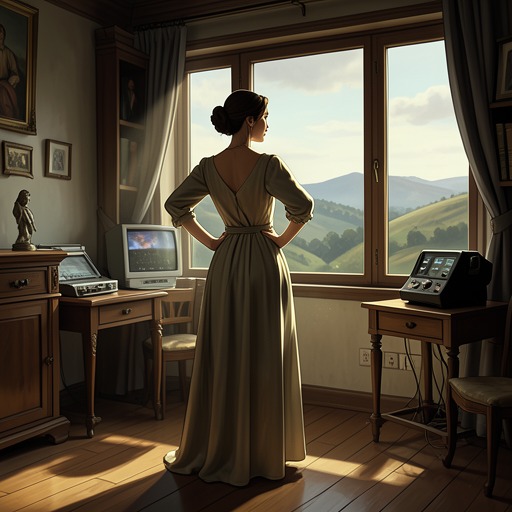
Constance Reid and Clifford Chatterley’s marriage
Lady Chatterley's LoverConstance Chatterley and Clifford Chatterley’s marriage begins as a wartime union of companionship, then becomes a bond reshaped by injury, childlessness, public scandal, and a refusal to end it. Its course links private intimacy to the family’s demands, the aftermath of war, and the legal and social consequences of marital breakdown.
Formation in Wartime
After Herbert’s death, Sir Geoffrey wanted Clifford to marry, though he said little; his unspoken insistence weighed on Clifford. Emma opposed the match, believing that Clifford’s marriage would betray the shared life the younger members of the family had represented. Clifford married Constance nonetheless in 1917, when he was twenty-nine and she was twenty-three. He was home on leave for a month, and the couple’s honeymoon lasted that same month.
The marriage was formed under the pressure of war and anticipated loss. The narrative presents them as close in a way that was not dependent on sexual satisfaction: their companionship mattered more to Clifford than sex, and Constance valued an intimacy she understood as extending beyond it. She nevertheless wanted children, in part as a counter to Emma’s opposition and judgment. That hope was overtaken by events before the couple could establish an ordinary married life.
Injury, Childlessness, and Wragby
Early in 1918, Clifford was sent home severely wounded. There was no child. Sir Geoffrey died of chagrin, and Clifford spent two years under medical care before being pronounced cured, though the lower half of his body remained permanently paralyzed. His survival made a return to life possible, but not to the future the marriage might have anticipated.
In 1920, Clifford and Constance returned to Wragby Hall, his family home. Clifford had become a baronet after his father’s death, and Constance was Lady Chatterley. They began housekeeping on an inadequate income in a house described as forlorn. Clifford’s elder brother had died in the war, his sister had left, and there were no other close relatives. Unable to have children, Clifford returned to the smoky Midlands conscious that he could not provide an heir to carry on the family name. The marriage therefore carried both a private loss and a dynastic burden.
Exposure and the Pressure of Divorce
Years later, Bertha Coutts’s public accusations brought Constance’s relationship with Oliver Mellors into the scandal surrounding the marriage. Bertha named women she alleged had been kept at the cottage, and the resulting talk drew respectable names into public disrepute. An injunction was taken out against her. After Bertha found a book bearing Constance’s name in the hut, she began identifying Lady Chatterley as Mellors’s partner; the news reached both the rector and Clifford, who took legal steps against Bertha.
The exposure made the marriage’s private rupture a matter of public reputation and legal action. When Constance later asked Clifford to divorce her, he refused. She suggested that Duncan Forbes could serve as a pretext, sparing the need to bring Mellors’s name into the case, but Clifford remained resolute: he said he would never divorce her because he was not inclined to do so. The exchange leaves Constance’s wish to leave opposed not by a negotiated settlement but by Clifford’s exercise of control over whether the marriage would formally end.
Public Meaning
The marriage also figured in the novel’s later public interpretation. During the 1960 trial concerning Penguin Books’ edition, testimony defending the work treated the baronet’s impotence as a symbol of a culture unable to meet human needs, and the gamekeeper’s love affair as a return to a more intense life. That reading made the Chatterley marriage more than a private history: its damage and persistence became part of the novel’s argument about the distance between social respectability and human intimacy.